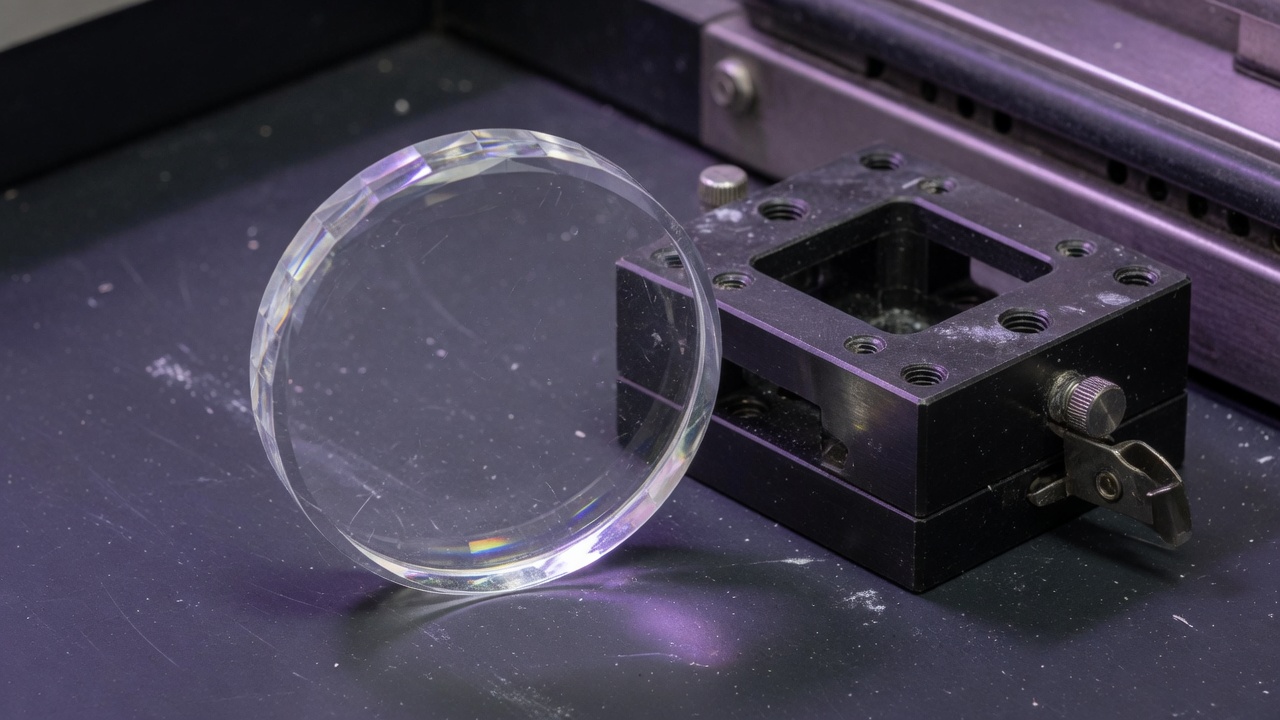
Calcium fluoride is the broadband crystalline window when the instrument must see from the UV into the mid-IR without going opaque in the visible the way Ge does. Crystran quotes useful transmission roughly 0.13–10 µm, grade and thickness dependent. n is about 1.399 at 5 µm — Fresnel is modest compared with ZnSe or Ge, which is why uncoated CaF₂ still shows up on FTIR benches. The long-wave edge near 9–10 µm (≈ 1000 cm−1 on a thick window) is why it does not own a 400 cm−1 fingerprint scan. For 4000–1200 cm−1 gas work it is often the right crystal.
What it will not do
It will not replace Ge on 8–12 µm thermal. It will not replace sapphire on a rain-and-sand dome. CTE is high (handbook values around 18.9×10⁻⁶ K−1). Thermal shock and hard mounts crack it. Knoop is low versus sapphire. Slightly hygroscopic compared with ZnSe; still a laboratory crystal, not a process viewport in wet HF.
Coatings
A single AR from 200 nm to 10 µm is not a stack, it is a wish. Write the band that matters (200–400 nm excimer vs 3–5 µm MWIR) and accept the rest. Uncoated is acceptable on many low-power spectrometer paths because the index is low. Map the band in the Spectral Explorer, then the RFQ.
References. Crystran CaF₂ data (band, index). Palik, optical constants of CaF₂. Shimadzu FTIR window notes. Harris, SPIE (1999), fluoride windows vs ZnS/sapphire in the environment.