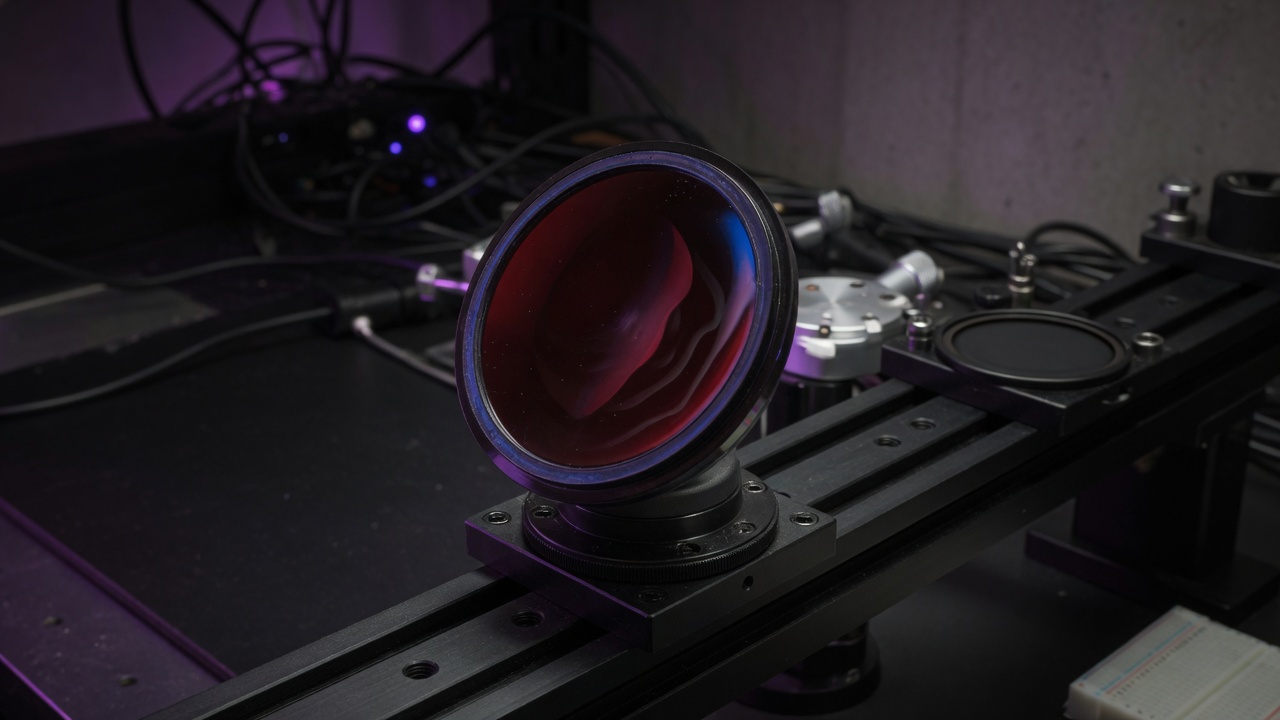
Chalcogenide glasses exist because IR designers wanted glass-like molding with crystal-like LWIR transmission. The commercial families are Ge–As–Se (AMTIR-1 is Ge33As12Se55) and Ge–Sb–Se (IG6 / IRG26 class). Index is typically 2.5–2.6 in the LWIR — lower than Ge (~4), higher than ZnSe (2.40). A molded asphere at volume undercuts diamond-turned Ge. A one-off prototype usually does not.
Do not drop-in replace Ge
dn/dT of these glasses is large and the opposite sign from some crystals, depending on the melt. Dispersion is not Ge. Same radii, same thickness, different MTF. Harris (SPIE, 1999) treats them as a separate class from CVD ZnS/ZnSe. Write the glass code on the print (AMTIR-1, IRG26, IG6), not “chalcogenide.”
Molding vs diamond-turn
Precision glass molding is the cost curve. Tooling lead time dominates. Below a few hundred pieces, diamond-turned Ge or ZnSe often ships first. Coatings must be qualified on the glass — adhesion and humidity on As-bearing melts are not the ZnSe stack. Qualify the finished coated lens, not the bare blank datasheet.
Send annual volume, band (3–5, 8–12, or both), and whether the part is molded or crystalline. Spectral Explorer, then the RFQ.
References. Amorphous Materials AMTIR-1 data (Ge33As12Se55). Schott IRG / Vitron IG glass datasheets. Harris, D.C., SPIE (1999). Hilton, A.R., chalcogenide glass reviews for IR optics.