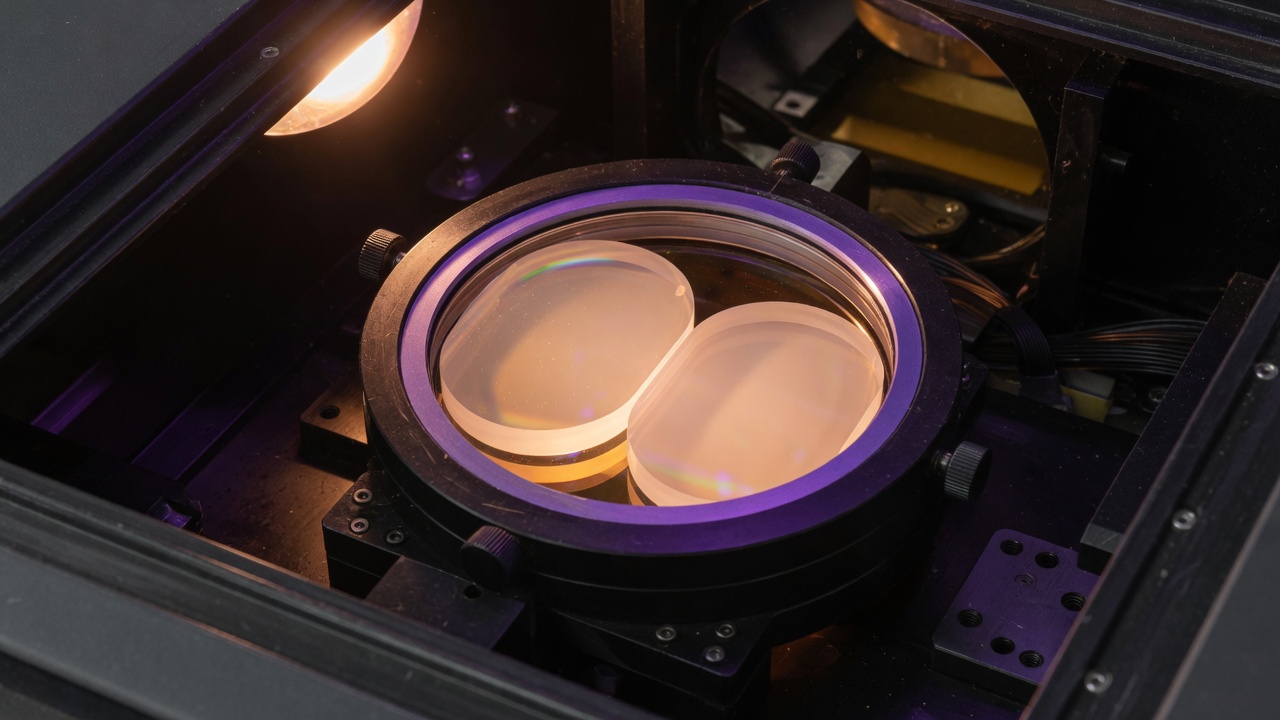
A plane-parallel window in a collimated FTIR beam is a Fabry–Pérot. The free spectral range in wavenumber is Δν ≈ 1/(2 n L) for a two-surface round trip, with L the thickness. For 3 mm ZnSe (n ≈ 2.4) that is about 0.7 cm⁻¹ — right in the middle of a 4 cm⁻¹ resolution survey scan. You see it as a sinusoidal baseline on every background. Software can flatten some of it. It cannot recover bands that sit on a fringe node.
How much wedge is enough
A wedge walks the multiple-reflection beam off the detector (or at least off the Jacquinot stop) and chirps the etalon so the fringe period is no longer stationary across the pupil. 0.5° is the catalogue default. At 3 mm that is 26 µm of thickness change across a 3 mm beam — several fringes of shear. For high-resolution work (0.5 cm⁻¹ and below) or for windows that stay in the beam as a permanent purge window, 1° is cheap insurance. Do not wedge a window that is also a vacuum viewport with a metal seal designed for parallel faces unless the cell was designed for it.
Wedging also adds a small prism deviation. At n = 2.4 and 0.5°, deviation is ~0.7°. Your beam must still hit the detector. Put the wedge orientation on the cell drawing (arrow toward source or toward detector) so every replacement part does not realign the bench.
Material vs the 4000–400 cm⁻¹ bench
KBr covers the full classical mid-IR with almost no fingerprint of its own. It is hygroscopic. A KBr window on a humid loading dock is a fogged window. Use it in a purged bench, store it dry, and do not pretend it is a process window.
CaF₂ is the broadband laboratory workhorse from the UV to about 9–10 µm (≈ 1000 cm⁻¹) depending on thickness. It does not cover a 400 cm⁻¹ far-fingerprint on a thick window. It is hard, not hygroscopic, and you can align with a visible laser. For 4000–1200 cm⁻¹ gas analysis it is often the right answer.
ZnSe takes you through 20 µm with a visible alignment channel. Absorption and reststrahlen behaviour at the long-wave end, plus the 17 %/surface Fresnel hit if you skip AR, are the costs. AR-coated ZnSe for FTIR should be specified over the wavenumber range you actually scan, not “AR 8–12 µm” copied from a thermal camera print.
Ge is excellent in the LWIR and useless for a visible alignment beam. It also has a huge Fresnel reflection (n ≈ 4). Uncoated Ge in an FTIR is an etalon with 36 % per surface. Coat it or do not use it as a window in a collimated beam.
AR, purge windows and cells
A liquid cell wants short path, parallel inner faces (the sample is the etalon you want, or an ATR crystal), and windows that do not dissolve. A gas cell wants wedged windows, AR matched to the band, and a statement of pressure and chemical exposure (HF, ammonia, wet CO₂). A spectrometer purge window that never comes out should be specified once, coated, wedged, and bought as a spare in the same lot.
RFQ fields that prevent a second PO
- Wavenumber range (or µm), resolution, and whether the window is always in the beam.
- Wedge: 0 / 0.5° / 1°, and orientation.
- Clear aperture, thickness, mount (O-ring groove, pipe thread, loose).
- Environment: purge, vacuum, process gas, humidity.
- AR: uncoated, single-band, or the actual scan range.
InfraSpec Optics supplies CaF₂, ZnSe and Ge FTIR windows as uncoated or AR-coated parts, wedged when the spectrum requires it. If your background has a comb, send a screenshot of the spectrum and the window drawing — that pair diagnoses the etalon in one pass.
References. Fabry–Pérot FSR Δν ≈ 1/(2 n L). Crystran ZnSe n = 2.4028 at 10.6 µm. TYDEX plane vs wedged spectroscopy windows. International Crystal Laboratories wedged FTIR components. Typical 0.5° air-gap wedge on a Bruker beamsplitter is documented in atmospheric-measurement work (e.g. Atmos. Meas. Tech. 14, 1239, 2021). Shimadzu FTIR window-material notes (KBr, ZnSe, KRS-5).