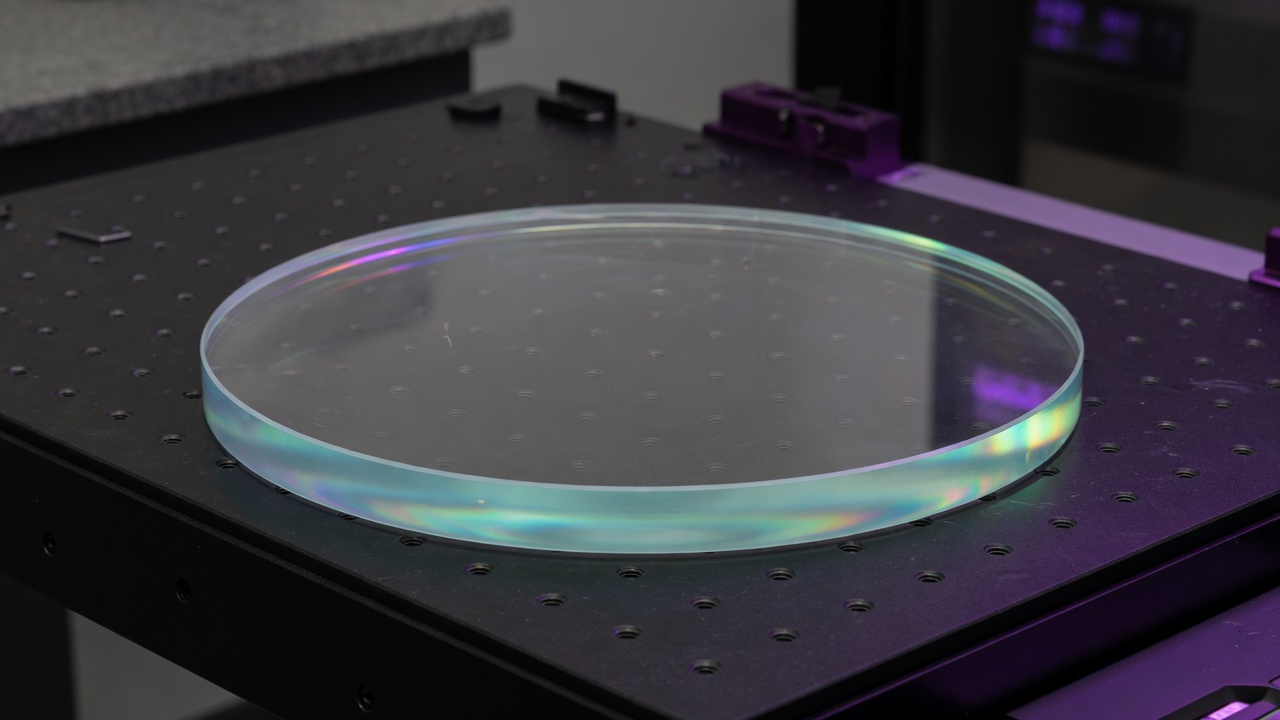
Fused silica is the amorphous workhorse from the deep UV through the near-IR. Corning 7980-class i-line grades go below 200 nm; standard UV grades sit around 185–2500 nm depending on thickness and OH. nd is about 1.458. CTE is ~0.5×10⁻⁶ K−1 — that is why it survives thermal shock that kills CaF2. It is not an LWIR crystal. Multiphonon absorption closes the window well before 10.6 µm. Polish does not create transmission the lattice does not have.
OH is a spec, not a footnote
The 1.38 µm and 2.2 µm OH bands eat NIR lasers. “IR-grade” or dry silica is the callout for 1.5–2.7 µm work. UV-grade with high OH can be the right buy for 193/248 nm and the wrong buy for a 2 µm window. Write the laser line, not “fused silica.”
What to put on the print
Grade (UV / i-line / IR), OH if the line sits near a water band, scratch-dig, transmitted wavefront at a named test λ (ISO 10110-5 — see the λ/10 note), and the coating as a separate line. High-power NIR failures are usually coating and cleanliness, not bulk index. If the drawing says 8–12 µm and the material is SiO2, stop the RFQ. Map the band in the Spectral Explorer.
References. Corning HPFS 7980 data (UV edge, nd, OH). Palik, optical constants of SiO2. ISO 10110-5 figure. Harris, SPIE (1999) — silica is not an LWIR window.