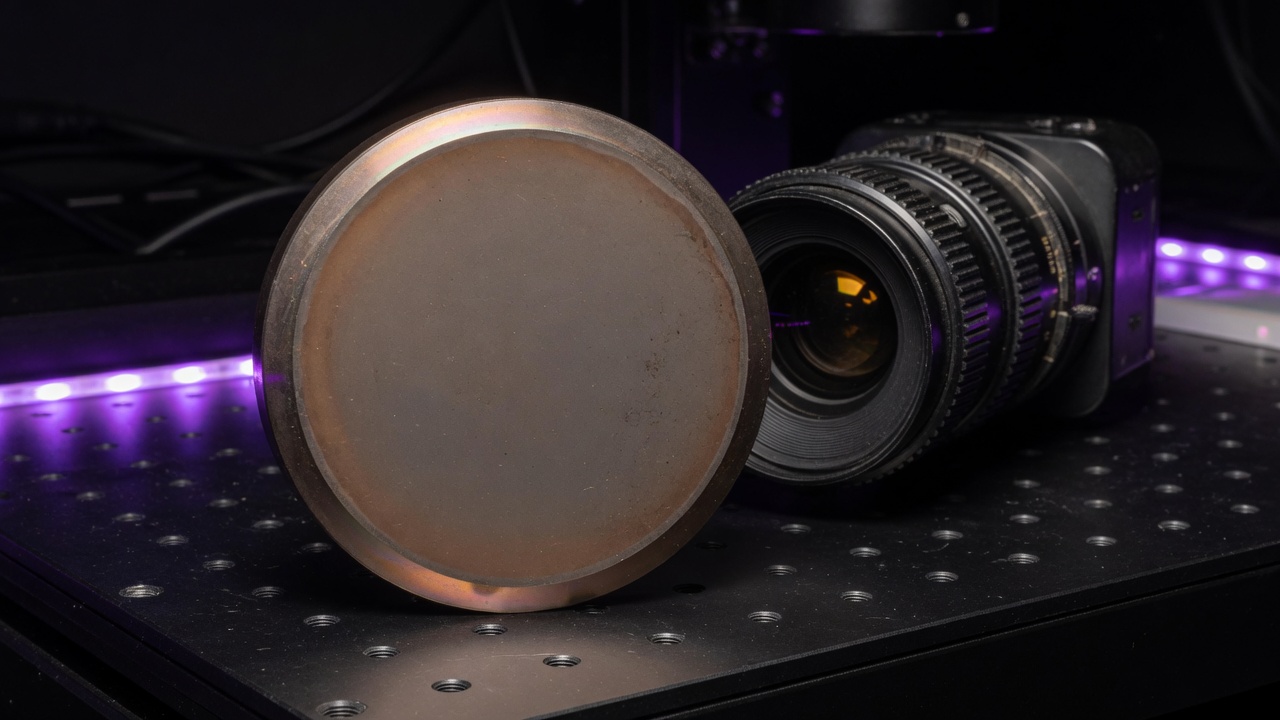
Germanium is the default high-index workhorse for uncooled LWIR imagers (8–12 µm or 8–14 µm). Index is about 4.003 at 10 µm and 4.025 at 4 µm — that is why a Ge singlet can replace two ZnSe elements. Transmission covers the thermal atmospheric band used by most bolometer cameras. It is opaque below about 2 µm. There is no HeNe through the same window. Knoop hardness is around 780, roughly twice MgF2 and far above CVD ZnSe (105–120). Harris treats it as an imaging crystal, not a high-power CO2 window.
Why you coat it
One air–Ge face at n ≈ 4 reflects ((4−1)/(4+1))² = 36 %. Two uncoated faces dump most of the beam. LWIR AR is not cosmetic: it sets average T across 8–12 µm and drives narcissus and cold-stop efficiency. Write the band on the print (8–12 vs 7.5–13.5) before anyone freezes the stack. Dual-band VIS+LWIR on germanium is a fantasy — the bulk does not transmit the visible.
Thermal runaway — the paper, not the folklore
P. A. Young, Appl. Opt. 10, 638–643 (1971), measured 50 Ω·cm Ge from 300–450 K. At 10.6 µm the absorption is free-carrier, not lattice. For each cooling scheme there was a critical power density Pc; above it the window ran away. Highest Pc in that work was 88 W/cm² with the germanium cooled below ambient. Handbook language since then is that Ge transmission starts to sag near 70–100 °C and falls apart by 200–300 °C. That is why a CO2 focusing lens is ZnSe, not Ge. dn/dT of Ge is about +396×10−6 K−1 — six times ZnSe’s +61×10−6 at 10.6 µm. A warm Ge imager lens walks focus; a warm Ge laser window can run away.
What to put on the RFQ
Resistivity / optical grade, band, AR, whether the part is diamond-turned (aspheres are common), and the temperature the housing actually sees. Polycrystalline vs monocrystalline is a cost and size call. Ge machines well. It is still a fielded outdoor window only if the coating and the cleaning protocol survive the shop, not the brochure.
Compare Ge against chalcogenide and ZnSe at your band in the Spectral Explorer, then send the print.
References. Young, P.A., “Thermal Runaway in Germanium Laser Windows,” Appl. Opt. 10, 638–643 (1971). Harris, D.C., Materials for Infrared Windows and Domes, SPIE (1999). Crystran Ge data. Photonics Handbook, IR materials (dn/dT, Knoop ~780, opaque < 2 µm).