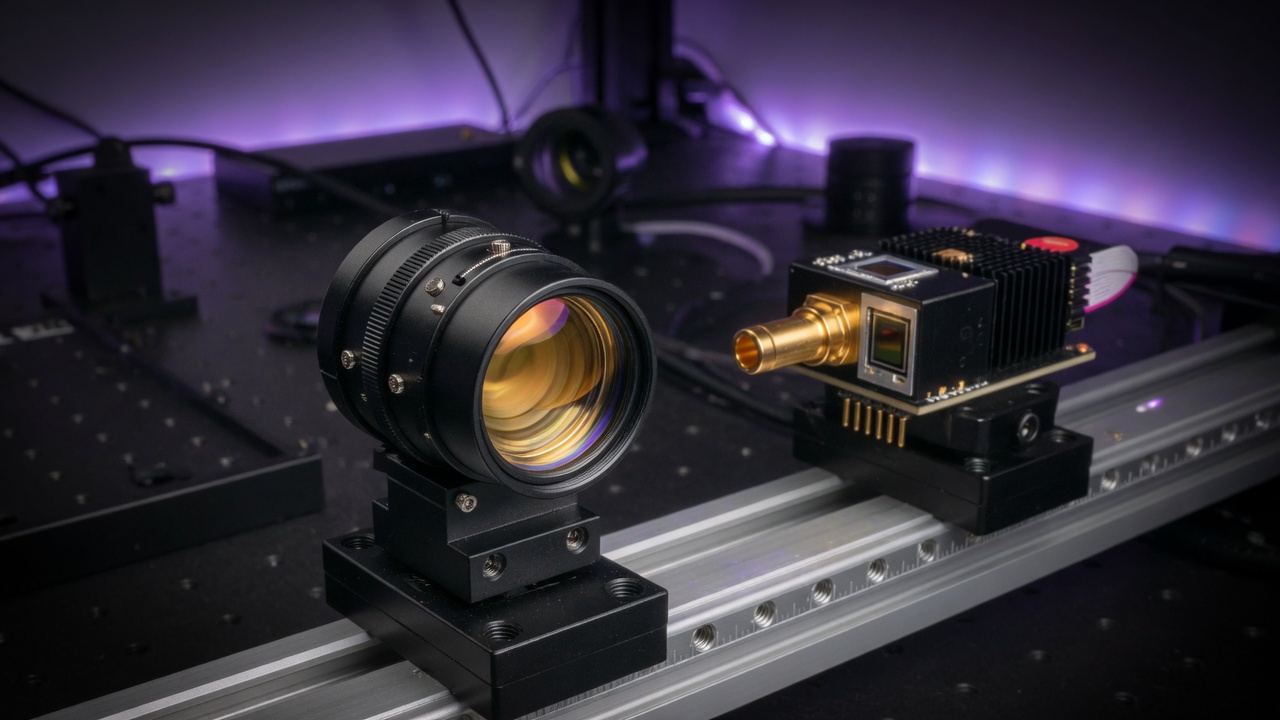
Distributed-feedback QCLs used for CO, CO₂ and CH₄ sensing around 4.3–4.8 µm emit from a waveguide a few microns high. Fast-axis divergence of 40–60° FWHM is normal. Slow-axis is milder, so the raw beam is astigmatic. A spherical ZnSe plano-convex sized from a CO₂ catalogue (f = 25 mm, Ø 25 mm) underfills one axis, aberrates the other, and leaves you with a collimated-looking blob that still has 3–5 mrad residual — enough to walk off a 50 mm detector at 10 m.
Match NA, then pick the surface
The collimator clear aperture and focal length must capture the fast axis: NA ≈ n sin θ, with θ the half-angle you actually need (not the 1/e² marketing number unless you measured it). For 50° full-angle in air you are already above 0.4 NA. A spherical surface at that NA on ZnSe (n ≈ 2.43 at 4.6 µm) has severe spherical aberration. An asphere — diamond-turned ZnSe or Ge, or a molded chalcogenide — is the correct first lens, not a “better sphere”.
Germanium’s higher index (n ≈ 4.0) lets you get the same optical power in a thinner, less steep asphere, which helps diamond-turning tool radius and scatter. The cost is weight, dn/dT, and no visible alignment channel. ZnSe lets you see a red tracer through the same optic. For a handheld analyser, that alignment channel is worth the extra aspheric departure.
Astigmatism is not optional
If the QCL astigmatism is not corrected, the fast and slow foci do not coincide. A single asphere placed at one conjugate collimates one axis. Options: (1) a cylindrical pair, (2) an anamorphic prism after a fast asphere, (3) accept a compromise waist and stop the beam. For spectroscopy into a single-mode fibre or a long cell, you cannot accept (3). Put the manufacturer’s fast/slow divergence and the emitter dimensions on the RFQ. “Collimate this QCL” without those numbers is not a request we can hold a tolerance to.
Coatings at 4.6 µm
Uncoated ZnSe still reflects ~17 %/surface in the MWIR. AR at 4.6 µm is a different stack from 10.6 µm. Dual-band 4.6 µm + 650 nm is common for alignment. Do not reuse a 10.6 µm AR drawing and expect 4.6 µm to be dark. Residual R of 0.5–1 %/surface is typical; sub-0.2 % wants a custom multilayer and a witness at the design λ.
What “collimated” should mean on a drawing
- Residual divergence (full-angle) at a stated power and temperature.
- Beam diameter at the collimator exit and at 1 m.
- Pointing stability vs temperature if the barrel is aluminium and the lens is ZnSe (CTE mismatch).
- Clear aperture and barrel thread (often SM1 / custom).
InfraSpec Optics builds QCL collimators and MWIR aspheres as coated assemblies, not as catalogue spheres. Send the laser datasheet page with divergence plots — that page is the optical design.
References. Faist, J., Capasso, F. et al., “Quantum Cascade Laser,” Science 264, 553–556 (1994). Connolly / Crystran ZnSe n ≈ 2.43 at 4.6 µm (same CVD table as 2.4028 at 10.6 µm). Young, P.A., Appl. Opt. 10, 638 (1971) — why Ge is a poor high-power path even when the index is convenient. Manufacturer QCL far-field plots (fast/slow FWHM) are the input, not a catalogue f = 25 mm ZnSe sphere.