CVD ZnSe is used on multi-kilowatt CO₂ cutters because bulk absorption at 10.6 µm can be held to ~5×10⁻⁴ cm⁻¹ in laser-grade material — five parts in ten thousand per centimetre. That sounds like nothing until you put 4 kW through 5 mm of it. Absorbed power is α × L × P ≈ 0.0005 × 0.5 × 4000 ≈ 1 W in the bulk, plus coating absorption on two surfaces. One watt, radially peaked like the beam, is a thermal lens.
The coefficient that actually moves focus
The thermo-optic coefficient dn/dT of ZnSe is approximately +6×10⁻⁵ K⁻¹ in the IR. Temperature rise in the beam centre relative to the edge produces a radial index gradient. Optical path difference OPD ≈ (dn/dT)·ΔT·L. A 5 K on-axis rise through 5 mm is 1.5 µm of OPD — about 0.14 wave at 10.6 µm, enough to defocus a cutting head that was aligned cold.
Germanium is worse: dn/dT is about +4×10⁻⁴ K⁻¹, nearly an order of magnitude higher, and Ge absorption rises with temperature (free-carrier). That is why Ge is a thermal-imager material and a poor high-power CO₂ window. ZnS is harder and more rain-resistant but typically higher absorption at 10.6 µm than laser-grade ZnSe. Do not swap them to “save cost” on a 3 kW head.
Beam diameter is the spec you forgot
Intensity scales as P / (π w²). Halving 1/e² diameter quadruples on-axis heating. A window that is quiet at 12 mm beam diameter will lens hard at 6 mm even at the same power. Always put 1/e² diameter, M² if you have it, CW vs gated, and whether the beam is focused in the optic (it should not be) on the RFQ.
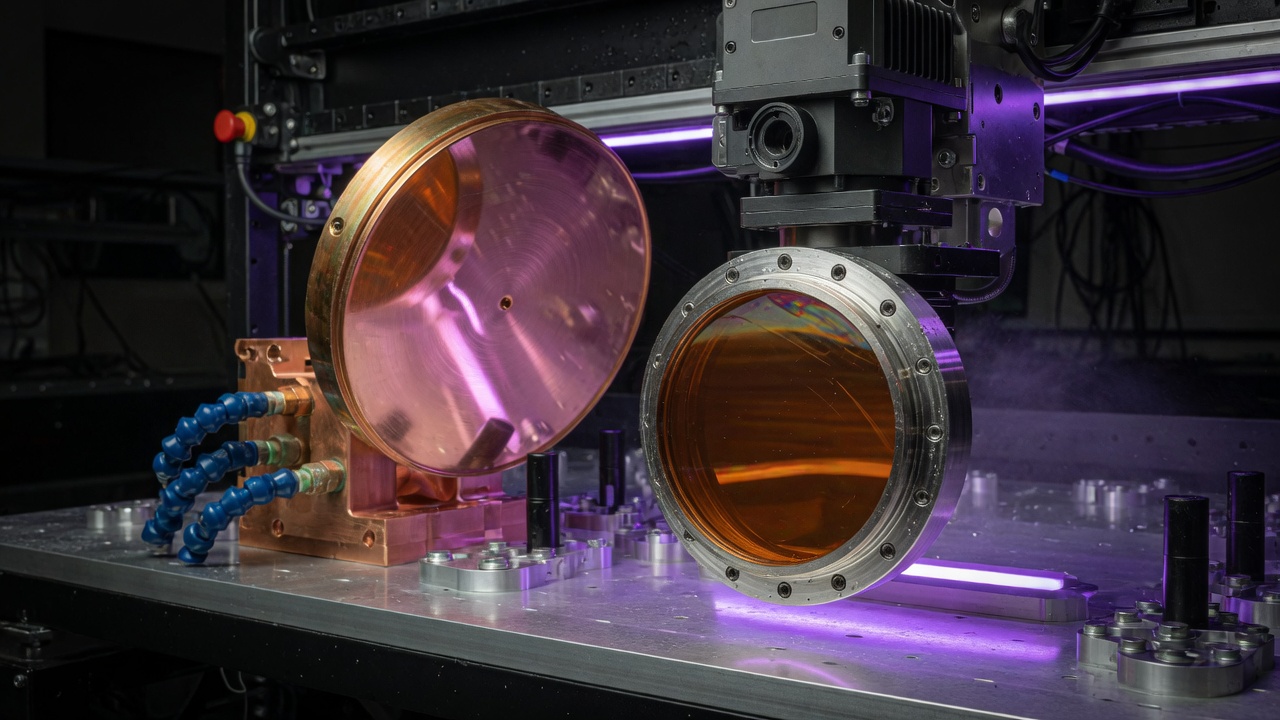
Cooling the mount helps the edge, not the centre, unless the optic is thin and the conductivity path is short. Water-cooled copper mirrors take the folds. Transmissive ZnSe still has to dump heat through the barrel. Edge-cooled thick windows develop a larger radial ΔT than thin ones. There is a reason industrial ZnSe windows for kW heads are not 12 mm thick “for stiffness”.
How it shows up in the field
- Focus wander over the first 30–90 s after beam-on, then a plateau.
- Cut quality that is acceptable at 1 kW and blunt at 3 kW with no mechanical change.
- A window that looks clean but has a faint central discoloration — coating absorption, not bulk.
What we quote against
Laser-grade CVD ZnSe, inclusion class stated, AR both sides with absorption called out, calorimetry or spectrophotometer plus a process recipe that has run at your power class. If the head is dirty (spatter, oil), budget a debris shield rather than over-specifying the focusing lens. A $40 sacrificial window in front of a $400 meniscus is how the line stays up.
Send power, beam diameter, duty cycle and whether the optic is a window, meniscus or asphere. We will tell you if ZnSe is the right substrate or if you should be on copper and a reflective path instead.
References. Hellma CVD Zinc Selenide® (α = 5.0×10⁻⁴ cm−1 at 10.6 µm; dn/dT = 6.1×10⁻⁵ K−1; k = 18 W m−1 K−1). Crystran ZnSe. Young, P.A., Appl. Opt. 10, 638–643 (1971) — Ge free-carrier runaway at 10.6 µm. Harris, D.C., SPIE (1999).